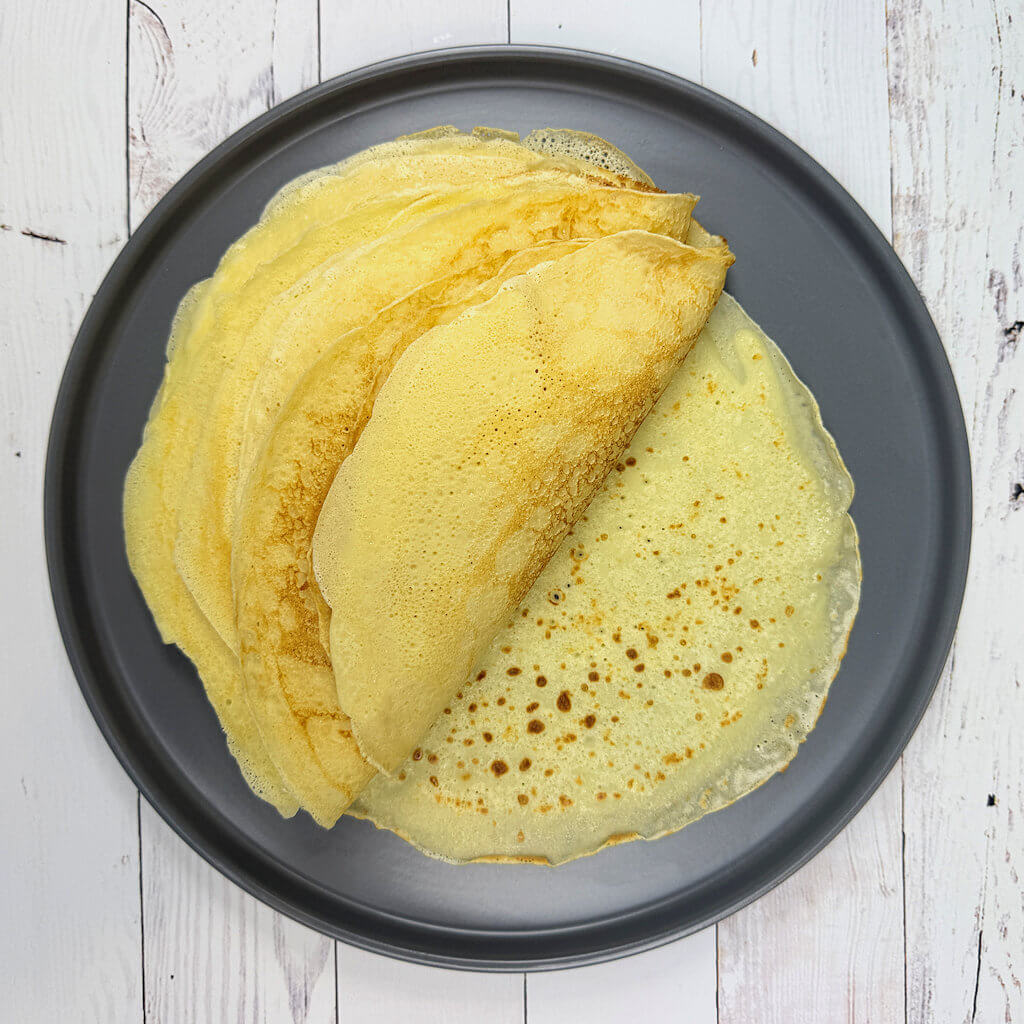
The most important thing to know about baking crepes is that the first crepe is almost always a test. Eat it in the kitchen and move on. And, the plain crepe is just the beginning. This post covers the technique and then offers a range of fillings; sweet and savory, so you can take the same small batch of batter in whatever direction suits the meal. Master the method once, and crepes become one of the most versatile things in your cooking for two repertoire.
There are basically two types, the crêpes and the galettes. The crêpe is based on white flour and the galette is made from buckwheat flour. The first is traditionally sweet, the best known may be Crêpes Suzette (served in the orange butter sauce, flambéed with an orange liqueur, like Cointreau or Grand Marnier).
The galette has a slightly heartier texture and a more pronounced flavor and thus paired traditionally with savory fillings. But I’m sure there is no reason why you cannot break the mold and make savory crepes or sweet galettes.
In this post I will focus on the crêpes, the ingredients, the way to make them, to fold them and a number of way to fill or flavor them.
This post may contain affiliate links, which means that I make a small commission off items you purchase at no additional cost to you.
Key Ingredients in This Recipe
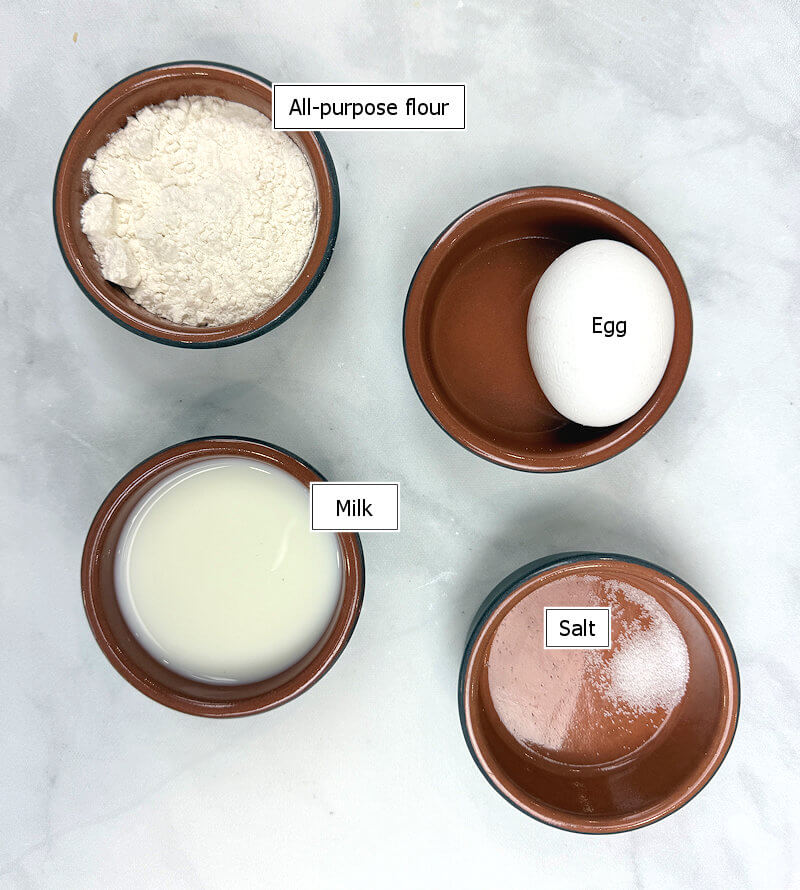
You’ll find the complete list of ingredients and exact quantities in the recipe below.
- All-purpose flour
- Salt
- Milk
- Egg
- Butter – or oil or cooking spray
What You’re Looking For in the Pan
Before you pour, the butter needs to be just past the foamy stage, still pale, not yet browning. That’s the window. Too early and the pan isn’t hot enough; too late and the butter will burn before the crêpe sets. When it looks right, pour in your ¼ cup of batter and immediately start tilting and rotating the pan to spread it toward the edges. The batter is thicker than it looks and won’t flow on its own, you’re coaxing it, not waiting for it. Work quickly; within a few seconds it will start to set and you’ll lose the ability to spread it further.
You’ll know the crêpe is ready to flip when the edges look dry and slightly curled, the surface has lost its wet sheen, and the bottom releases cleanly from the pan when you slide a spatula underneath. Don’t rush the flip, a crêpe that’s not ready will tear. One that’s ready will come up in one piece and take less than a minute on the second side.
How to Make Crêpes
One note I would like to make before getting into the how of making crepes. I have experienced (and after googling it, I found out that I was not the only one), that often the first crepe is not the most beautiful one. It may be that I was to eager to start or my skillet was not hot enough yet, or I waited too long and my skillet was too hot or I poured too much or too little batter. So learn from the first and pour the second one and see how that goes.
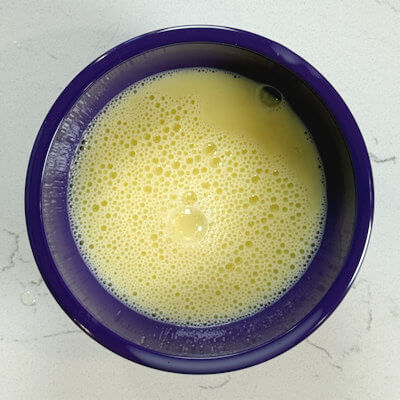
Step 1 – Mix together milk and egg until you have a homogeneous mixture.
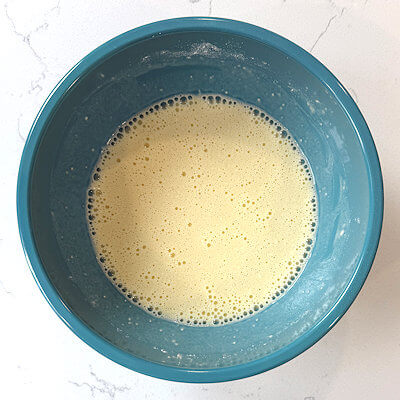
Step 2 – Mix flour and salt. Add the egg mixture, little by little and mix until combined. If you have tiny lumps, you can strain the batter.
For the best result, allow the batter to rest, min. 1 hour or overnight. This is not a must, but allows the dry ingredients to absorb moisture and loosens up the gluten. The batter will cook more evenly, resulting in a softer thin pancake.
Step 3 – Heat a 10-inch nonstick skillet (you can also use a crêpe pan) over medium heat and brush with butter. You may need to add some milk or water to thin the batter. Ladle 1/4 cup of batter into the pan, turning and tilting the skillet to coat the bottom (when the batter is too thick because of the rest, it’s harder to coat the bottom of the skillet). Cook until the top of the crêpe is set and the bottom is golden brown. Turn with a spatula and cook the other side in less than 1 minute.
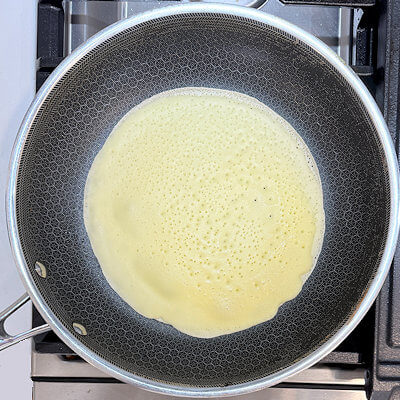
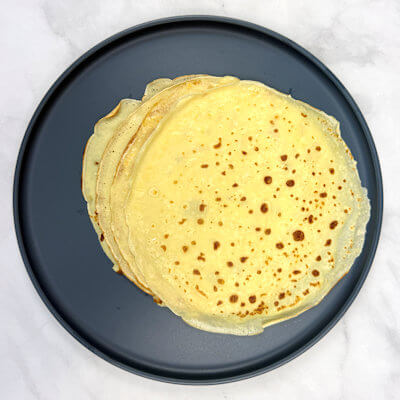
Step 4 – Transfer the crêpe to a plate and continue baking with the remaining batter.
Varieties and Substitutions
- Type of flour – Use whole wheat flour or buckwheat flour, but keep in mind that these flours absorb more liquid, so you’ll need to up the amount of milk or add a little bit of water. Alternatively, you could try a 50:50 mixture (half all-purpose flour and half whole wheat or buckwheat flour). Quinoa flour is a gluten-free alternative that does not need any additional liquid. Crêpes don’t need gluten; they are not supposed to be fluffy, so a gluten-free flour will do as well as a gluten-containing flour.
- Sugar – If you are making a sweet crêpes, you could opt for adding a little bit of sugar to the batter, like 5 grams in this recipe. I don’t believe it is necessary, as the filling or drizzle will have a much larger impact than a little bit of sugar in the batter.
- Milk – Any type of milk you like. Whole milk or skimmed milk will have little impact on the flavor of the crêpes. Other types of milk, like almond, soy, oat milk or any other plant-based milk can work as well, but those do change the flavor of the traditional crêpes.
- Butter – both salted and unsalted butter are good. I don’t see the necessity to recommend either, the amount of butter is very small and thus the amount of extra salt coming from the salted butter will certainly not affect the flavor. Instead of butter, oil or cooking spray can be used.
- Add some cocoa powder and make chocolate crepes.
- Mixing fruit pulp or vegetables into the batter for a whole other take on crêpes. Examples may follow.
How to Fold or Roll Crêpes
Folding crêpes is part of the fun. There are a number of ways to fold or roll crêpes, below are 6 varieties. There are more, but I focused on the practical ones. What method you use may depend on the filling and the time of serving.
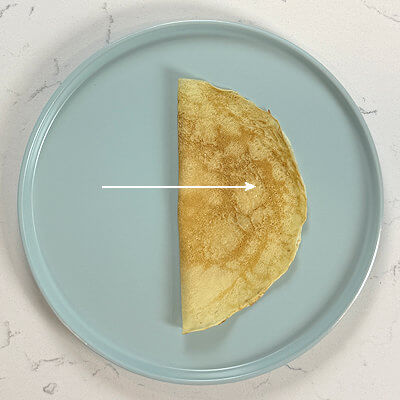
- The double fold. Fold a crêpe in half. You’ll end up with a half circle or a half moon.
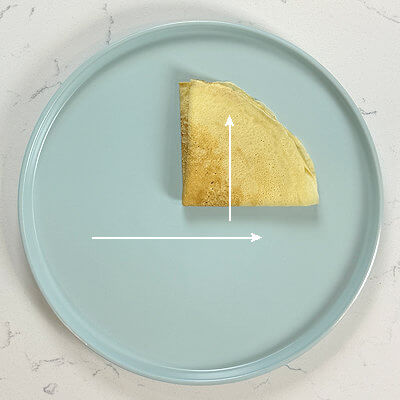
2. The 1/4 fold. Fold a crêpe in half, creating a half moon. Fold the half moon in half again and you’ll end up with a 1/4 circle.
3. The 1/3 fold. Fold a crêpe in half, creating a half moon. Fold the half moon 1/3 of the way up and then fold the other side over the already creating triangle.
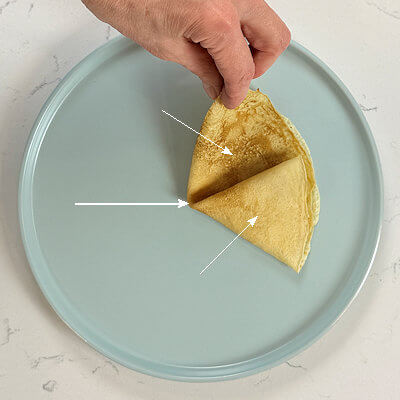
4. The simple roll. Lightly roll the crêpes. Don’t roll too tight or you’ll squeeze the filling out of it.
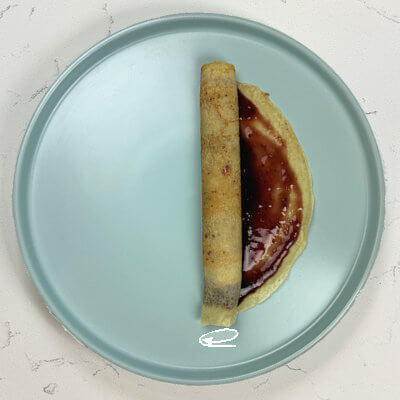
5. Cone roll. First fold the crêpe in half, creating a half moon. Then place a finger in the middle of the straight line and roll the outside from right to left, forming a cone.
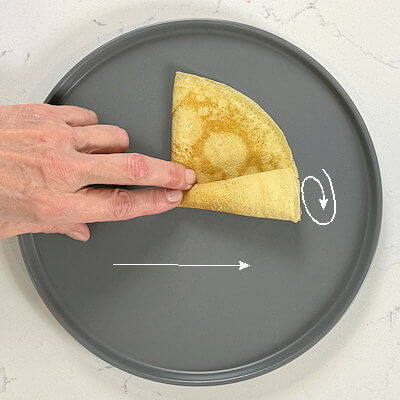
6. The ‘Burrito roll’. First bring the left and right edges toward the center, partially covering the filling. Roll the bottom part of the crêpe over the fillings, while keeping the sides tucked in. Roll until it you reach the other side.
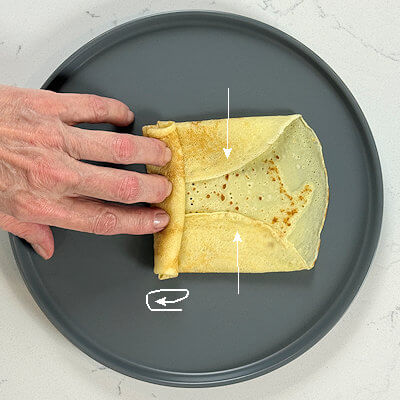
7. The last way to fold is an open fold, but that’s more often done with a galette than with a crêpe, so I’ll show you that when I make a buckwheat galette.
Crêpes Fillings
This list is definitely not exhaustive; that would be a miracle if I was able to do that with all the choices you have at your disposal. This list of filling is offering types of fillings, you can fill in the flavors.
- Butter, sugar or syrup – this may be the simplest way to serve crêpes.
- Fresh fruit – on its own or with cream, yogurt or ricotta.
- Any type of preserves, jam or lemon curd or passion fruit curd.
- Ice cream and a drizzle of caramel sauce, nutella, chocolate sauce.
- Whipped cream or avocado cream.
- Sauce and liqueur – like Crêpes Suzette (served in the orange butter sauce, flambéed with an orange liqueur, like Cointreau or Grand Marnier).
- Spinach and cheese.
- Ham & cheese and egg
- Roasted vegetables
How to Store and Reheat Crêpes
If you’re making more crêpes than you’re going to eat (by the way, this recipe can easily be multiplied), then you’ll need a good way to store them.
- The best way to store crêpes is to put a sheet of parchment paper, or wax paper or plastic wrap between each crêpe. They won’t stick together and can be easily peeled off the parchment paper, when you need them. Cover the stack with plastic wrap or alternatively, place it in a resealable plastic. Refrigerate for up to 3 days or up to 1 month in the freezer. Thaw frozen crêpes in the fridge the day before eating.
- There are a few ways to reheat crêpes:
- On the stovetop – Warm one crêpe at a time in a non-stick skillet for about 30-45 minutes, the flip and warm the other side. No butter required.
- In the microwave – Place one or a few crêpes on a plate, covered with a damp towel and warm on high for 15-30 seconds.
- On the oven – Place a small stack of the crêpes on a baking sheet and cover them tightly with aluminum foil. Heat for about 10 minutes in a warm oven of 300°F.

Small Batch Basic Crêpes
Pin Recipe Facebook Share by TextIngredients
- 1/2 cup all-purpose flour
- 1/8 teaspoon salt
- 2/3 cup milk
- 1 egg
- 1 teaspoon butter
Instructions
- Mix together milk and egg until you have a homogeneous mixture.
- Mix flour and salt. Add the egg mixture, little by little and mix until combined. If you have tiny lumps, you can strain the batter. (NOTE 1)
- Heat a 10-inch nonstick skillet over medium heat and brush with butter. (NOTE 2)
- Ladle 1/4 cup of batter into the pan, turning and tilting the skillet to coat the bottom. Cook until the top of the crêpe is set and the bottom is golden brown. This will take about 1-2 minutes. Turn with a spatula and cook the other side in less than 1 minute.
- Transfer the crêpe to a plate and continue baking with the remaining batter until you have 4 in total.
Notes
- If you want to make the perfect crêpe, you should allow the batter to rest for a minimum of 1 hour, even an overnight rest is optional. Resting time will allow the dry ingredients to absorb moisture and loosens up the gluten. The batter that will cook more evenly, resulting in a softer thin pancake. But you can still get perfect crêpes within 15 minutes.
- Instead of butter you can use neutral oil or cooking spray.
Nutrition
Nutrition information is automatically calculated, so should only be used as an approximation.